In the time since my last Post - November 5, 2017, a Lot has happened in the world of Electric Vehicles!
Unfortunately - not so much with My Electricfly! I still have it, but I have been agonizing over selling it, or finding a place to work on it, that's more practical!
In the time since then, Tesla has sold over half a million BEV's, it would seem, mostly Model 3's, and my employer has had me busy working on the new Global 7000, now coined the Global 7500, over 50 of them!
I have also cleared up a stack of stupid debts, and saved a few dollars, along my plan to buy the Model 3, but also to save something for times like these, being Furloughed from work, for 4 weeks (Or More?), and not being greatly bothered by it. While the model 3 is a beautiful vehicle, performance and otherwise, I might be more suited - to the new Model Y! But - Tesla's Cybertruck finally captured me, and on March 4th, I put in a Reservation, for that!
Let's see if I can get back here with some good news, for Electricfly - before another 2-3 years pass!
Tuesday, April 7, 2020
Whoa! It's 2020 Already? Where has all the Time Gone?
Sunday, November 5, 2017
Common Electric Vehicle Charging Options, Networks, and Brands. (North America)
"When it comes to refueling a car, drivers of gas- and diesel-powered vehicles have it easy. They roll up to any one of about 100,000-plus gas stations in the U.S., pump in liquid fuel in a matter of minutes, and pay either in cash or with a credit card. Unfortunately, it’s a little more complicated with public charging for electric vehicles—although remember that almost all EV charging takes place at home, which usually requires about 30 seconds to plug in each night." - Quoted from "The Ultimate Guide to Electric Car Charging Networks" - linked at the bottom of this story.
"Sun country highway is the fastest level 2, Electric Vehicle (EV) charging network in the world today."
When it comes to Electric Vehicles, not many people know about the many different 'Brands' of Charging Networks, and - since unlike with Fuels, Not all Networks simply have a posted 'Meter' that shows how much you are being billed while you charge, and you often can't bill directly to a Credit Card, without some intermediary card, or 'Membership Card' to use their Branded Network, I thought I should add my preliminary take on this matter.Charging At Home - the First Stop.
Sunday, October 22, 2017
Work Continues on the Electricfly....Slowly!
While I have been silent for over a year, I have been thinking about the Electricfly, while I await the coming Model 3 from Tesla! I am doing some surface Mods, testing ideas out, actually, a few minutes here, and there, and it it progressing very slowly, between work, and catching up on other important outstanding commitments. News Will be brought here when I have some interesting pictures, and results to share. Please don't hold your breath, but stop by once in a while, anyway!
Sunday, April 17, 2016
My Electricfly and steps leading to reserving a Tesla Model 3!
If you have been following this Blog any bit at all in the past, you will have seen my continuing efforts and Struggles with the challenges of maintaining, improving, and upgrading the Electricfly!
From my discoveries about the much lower really Usable Energy Ratings of the Batteries I was using, that I bought 100 Ah Batteries, to discover they were rated at just 30 Amps for 1 hour! In any case - I was still trying to move forward, and improve the Safety of the Battery Boxes that were inside the Hatch Portion of the car; working on Body Work with the Roof, and the Hood, having more rust than I realized!
Past Experiences, and much reading had me realizing that the DC Motor in the car, while it worked, did not give me anything back, in the form of Regenerative Braking when I slowed down, causing greater use of Mechanical Brakes than should be required in an EV, so I renewed my investigation of AC Motors for Electricfly! I started Considering the largest Large Format Lithium Iron Phosphate (LiFePO4) Cells for the Car that I could fit in the Empty Gas Tank Area under the Rear Seat, in an attempt to get reasonable priced energy storage, lighter weight, and more energy into the car!
I then started comparing
Sunday, June 1, 2014
7 Day Sale on EV Fest 2014 Tickets!
Saturday, May 10, 2014
MyElectricfly: Old Electric Vehicles versus New Electric Vehicles: Sources & Links
Electricfly - is not (in some circles) an OLD Electric Vehicle, but - in this instance - it is (My) Old Electric Vehicle, as I am looking at two choices for it: Fix it - or Part out the EV Components and Save what I want to keep, and scrap the rest of the car!
The Challenge with Fixing it - is some of the already missing Rusted metal leads right up to the Right Front Suspension corners! Also - no matter how much I put into the car - it remains - underneath it all - a High School EV Conversion of a 1989 Pontiac Firefly (Geo Metro/Sprint/ Suzuki Forsa, etc.), and unless I create a whole new vehicle based on it - it will pretty much now always be a dying vehicle!
While the Actual Drive Train is still Strong, the car body is going to cost more and more to maintain or keep alive!
When it comes to Parting-Out the primary Electric Vehicle Components of my Electricfly - it has been suggested I put the items up for sale on the EV Trading Post, which I most likely will, but the offer will also go up here, possible first, if not at the same time! Watch for postings of GE Motor + Firefly Transmission - mated and ready to use!
Want to see what are some Really Old Electric Vehicles? Here is a timeline of Electric Vehicles that have been produced for sale: Electric Vehicles 19th Century to Today.
Also - the world of Electric Vehicles has changed a lot since I bought 'Electricfly' and delivered it home on October 12, 2006, and at that time - an EV Conversion was the only thing available, and even then - there were limited EV Conversion Manuals to guide you!
This Blog was started to follow the progress of My Electricfly - to report things done to it, and how they succeeded in making it better - or not! This Blog was not started at the time I got the car - but some time later on May 27, 2008! It has covered Battery Changes, new Instrumentation, Custom built Battery Charger packages I did myself, New Battery Management Systems, and more!
Currently found on EV Album, there are listings for 4,168 Vehicles: Some are OEM Factory Built, (a small few), but most are Electric Vehicle Conversions, Mods, or Custom Built variations. Some are two wheels, some are three wheels, but most are four wheel vehicles. Some go slow and some go fast! Some (a good number of vehicles built before the last few years) are powered by Lead Acid Batteries, but recently battery choices have increased - to offer NiMH (Nickel Metal Hydride), Lithium Ion, and Lithium Manganese Phosphate and Lithium Iron Phosphate, and Flooded Nickel Cadmium Choices - each with their own set of favorite benefits - Energy Storage, Cold Weather Operation, Weight, etc.
A Lot has changed since 2006, and now we have a growing number of choices of ready to drive, factory built, high quality Electric Vehicles, with a variety of body styles and performance capabilities, all available - either for driving off the lot, or for order!
Depending on where you live - there are a growing number of electric vehicles available for purchase - and listed on sites like These (Some of which are also listing both Regular Hybrids, and Plug-in Hybrids): Hybrid Cars, CAA, Wikipedia, Green Car Reports, etc.
Since 2006 - I have also began to be involved in creating Events - Electric Vehicle Shows:
EV Show & Shine BBQ in April 2010, EV Fest Electric Vehicle Show which began in October 2010 and continues today to EV Fest 2014 - our 5th Anniversary, and also Electric Avenue 2013 - an event done in conjunction with Formula North 2013!
EV Fest 2014 is Coming! Don't Miss out!
Sign up today for EV Fest News Updates!
Also - you can Follow EV Fest on Twitter, or on Facebook!
If you live in Ontario, Canada - at present they have the strongest and best Electric Vehicle Rebates offered in Canada, and also offer Rebates on the now common Level 2 Electric Vehicle Charging Stations for Home use, if you have bought a New Electric Vehicle (or Plug-In Hybrid) (and got the Rebate).
Friday, October 25, 2013
Tesla Model S: The electric car that goes the distance, for a price
Tesla Model S: The electric car that goes the distance, for a price - CTV News http://bit.ly/16BoOQ7
“@bill allen If you are aware of the Panasonic test data. The batteries will have still have 70% capacity after 2600 charge cycles. If you manage to drive it for 650,000 miles and find that 70% capacity is unacceptable, that may be an issue. Then again how many engine rebuilds will you go through during that time. Most cars last for less than 200,000 miles so the question you pose about the batteries is moot. For arguments sake, you did not need any engine/transmission repairs on your regular car, you would have spent roughly $75,000 in fuel. Even if battery prices stayed the same (they are dropping) and you didn't purchase the battery plan ($12,000), you would still make out ahead with the Tesla Model S battery ($40,000). Then again, for an average person, you would be retired by the time you reach that type of mileage so you would not need to replace the battery.”
Reading the Comments is an excellent study in people, and sometimes leads to new information, too!
Monday, September 2, 2013
EV Fest 2013 - On it's way and coming September 22nd, 2013
Well, My Electricfly might not be winning the war on rust at the moment - but EV Fest 2013 is on and coming to a new Venue! On September 22nd, 2013 - We will see EV Fest 2013 happening at 630 The East Mall in Etobicoke (Toronto), Ontario - the Home of BAKA Mobile and their 20 kW Solar Canopy/ Solar Carport with Eight (8) EV chargers - the most at one place in the City of Toronto, Ontario - to My knowledge.
Exhibitor Commitments are coming on board, as well as Paid Sponsors! In fact - our first Paid Sponsor this year - Ontario Kit Car Consultants - is at a step up from our biggest EV Fest 2013 Sponsor!
Full Details at http://blog.evfest.ca/ and at the website - http://www.evfest.ca/.
While it is not likely that Electricfly will make it to the show this year - it is not yet totally out of the question (Just not as much of my focus, as it might need to happen)!
While it might not make it - we hope to see you there - enjoying the many EV Exhibits from OEM EV's like the Tesla and Mitsubishi, to Personal EV Conversions like the Porsche 944 and Dodge Dart! We expect others - and we will see who they are shortly!
Saturday, August 31, 2013
My Electricfly - Struggling with Cancer - a time to decide it's fate!
When working on My Electricfly - I was struggling with a Seized Bolt and a Fender that had gotten Brazed to the Rocker Panel - and so I attempted to mam-handle it off - the old fashioned way: Cut it off, with a plan to re-attach it with a braze or well later, after cleaning up the Rust issues!
Unfortunately - in the process - I caused a large piece of (very rusty) metal to fall out of the under-body! Upon Closer examination - using a large mirror under the car and a light - I could see that the car's body was under attack by a large area of rust - body cancer - in my baby!
As such - since it is a 1989 Pontiac Firefly at its roots, being 24 years old, with questionable rust prevention both before my acquisition, and since, it is suffering with a major level of under-body rust.
While I have been working on ideas and research to integrate a new-technology battery chemistry - Lithium Iron Phosphate (LiFePO4) pack into the car - considering both Prismatic styles and Cylindrical styles, and coming to the plan to use Cylindrical Headway Cells in the original Gas Tank space for a 7.5 kWh Battery Pack, the car has been silently dying in front of me!
As a number of components on the vehicle have been added or upgraded by me - it is hard to just write it off. Installing Individual Battery Chargers was my first attempt at better battery management. This included using standard 12V Chargers - one for each Battery. I had a custom built case installed in the front of the car, with 4 such chargers inserted into the one case. Three of the chargers were for the front three traction batteries, and one was for the normally located accessories battery.
I also added, after discovering that even charging each battery individually was not enough to keep them drifting wildly apart on discharge, a battery charge balancing system, and also - a Individual Battery Monitoring System - which was able to allow me to see which batteries were going low first, and adjust my driving accordingly and sooner - saving extreme discharge from the Batteries.
A Newly machined and custom throttle connect was also created and integrated, so as to properly deliver a straight movement from the solid cased and sealed Throttle Pot to the Rotating throttle Pedal arm.
It also has an interesting and storied past, as well as ties to the development of some interesting transitional businesses in the world of Electric Vehicles. The original High School students that built it - have had further experience in the EV World, and after furthering their careers post High School, two of the students went on to create Hymotion - the Prius PHEV Conversion Company that used the original A123systems 26650 Cells in their Enhanced drive system. This was ultimately bought out by their Battery Supplier, and has since been closed down.
It was from reaching out and connecting with them, that I discovered more about this vehicle - since I was sent a pdf file with information about many of the original components - the motor, the controller, and the throttle pot.
Of course - the Car was acquired at a time when there were no OEM Electric Vehicles to choose from, and a lot was learned with it as I used it and developed better battery management control.
OF course - it forced me to do a lot of research on Batteries, and to learn about the differences between Battery Labeling, Specifications, and Reality in an Electric Vehicle when it came to Lead Acid Batteries.
Time changes many things, and one thing in particular - is that OEM Electric Vehicles (EV's) are now coming from Mitsubishi (iMiEV), Mercedes Smart (Smart ED), of course - the Nissan LEAF, The Ford Focus EV, and the Coming Chevy Spark EV. Also available new since I bought this car - are (if I could afford them) were the Tesla Roadster, and now the Tesla Model S - reported as the Best Vehicle ever - not just the best Electric Car!
Other Categories have been developed and delivered - the Chevy Volt Extended Range Electric Vehicle (a Variation of a Plug-in Hybrid, or PHEV), and others like the Toyota Prius PHV and the Ford Fusion Energi and the new Ford CMAX Energi, as well.
These are all new choices to pick from, that didn't exist in October of 2006 when I bought the Electric Firefly and began to brand it as My Electricfly!
Along this time - my own Internal Combustion Engine Vehicle collection has changed a few times - from a 2005 Chevy Optra Wagon bought in August 2005, rated at 10.9 L/100 km City, and 7.4 L/100 Km Highway, to a Leased 2008 Dodge Dakota SXT, rated at 14.4 L/100 KM City and 9.8 L/100 Km Highway (Traded the Optra, in January 2008), to buying a new 2010 KIA Soul, Rated L/100 km: 8.5 city, 6.6 hwy in July 2010. The Dodge Dakota was returned in December 2010 at an early end of lease completion. It had been used to tow my Electricfly to Ottawa EV Shows, Newmarket EV Shows, and Toronto EV Shows.
I have also bought a used 2004 Prius to experiment with the aftermarket Plug In Battery Options that exist. the Prius was used this year for a trip to Wisconsin, to attend Oshkosh AirVenture and on that trip got me a typical best average of just 4.5 Litres per 100 Kms. With such a good base of fuel burn - better than my KIA Soul by quite a bit, it has come down to thinking over the car equation: Keep the Prius and Buy an EV from an OEM, Sell (or Trade) the KIA Soul, and as for my Electricfly - the choices are a bit grim:
- Sell the Electricfly as is and hope for the best sale price,
- Take out the Good Stuff -Like the Custom Embroidered Seats, and sell it without seats,
- Take Everything out that is EV Related, and Scrap the Car,
- Sell Components (Motor , Controller, and Throttle Pot; Battery Equalizers; Tires/Wheels, etc.)
- Patch it up, clean up the surface rust and finish the progressing white paint job, and donate it to a museum (Oshawa?) for the History in it,
- Or - Trade? it in (with the KIA) at a Dealer - for a new Electric Vehicle!
With that said, I would like to hear some of your thoughts!
Of course - along the way - I have gotten involved in organizing Electric Vehicle Shows - helping with the first in 2010, the EV Show & Shine BBQ, with the Electric Vehicle Society and Scarborough Toyota, and then the first EV Fest - as EV Fest 2010 at Toyota On The Park, and continuing to develop EV Fest with EV Fest 2011 and EV Fest 2012 shows at the Evergreen Brick Works, and EV Fest 2013 coming to BAKA Mobile at 630 The East Mall. All of this has put me in touch with a variety of Electric Vehicles, their owners, and a few additional opportunities to experience them.
It was this experience that first lead me to buying the used Prius - with an eye to getting used to it - and then adding the Plug-in Hybrid upgrade from (as planned) the Enginer.us product line.
Between doing that - and outright buying a new EV is where I am working the thoughts at present, and trying to determine the best mix of having a Two-Car Collection - with a Hybrid and an EV, or to just have one car - and add the Plug-in pack to the Prius!
Friday, March 29, 2013
What to do with Old EV Batteries? Tesla has one Answer! General Motors and ABB have another!
In reading Articles about Electric Vehicles - some times the comments are all seemingly negative, but even then - I learn things by other peoples responses that I did not even know - like this one: "Tesla's Closed Loop Battery Recycling Program" from January 26, 2011.
The Key part of their information - beyond how much they can get back into usable products from batteries into new batteries and construction materials, was this line: "Working with Umicore has allowed us to completely recycle the Roadster battery packs profitably, without special financial incentives necessary to promote recycling (as opposed to the lithium manganese or lithium iron phosphate chemistries used in the electric vehicles just hitting the road now)."
It was interesting - as my own interest is in the Lithium Iron Phosphate Cells and Batteries! So when they say - "We already reuse cobalt in the batteries. The overall closed loop recycling system becomes possible, and much more efficient, once the quantities rise to a level to justify the investment for recycling of the other components – especially the plastic." - you can see that they have heard the question, and not just thought of the Answer - but began to work it already!
Besides Recycling their Lithium Cobalt Batteries - Tesla has been steadily learning that there are still people in the field of Journalism that can't get un-negative about electric cars - even the best Electric Car on the road today! So they find ways to make it fail, out of effort, ignorance, and bad judgement - as covered in this rebuttal by Elon Musk - A Most Peculiar Test Drive.
The Journalist said Cold Weather was Bad for the Car, But did they drive it on Ice Like Tesla Did?
Cold Weather Climate Testing the Model S
Saying it was never tested in cold - is just a punchline showing lack of research!
What to do with old EV batteries? Convert to energy storage system! GM + ABB Work on it!
General Motors (GM) and ABB have successfully converted used Chevy Volt batteries into a modular microgrid energy storage system that can support distributed generation and provide emergency backup power.
Other microgrid energy storage systems have recently come online, but this one is the first to revolve around batteries from electric vehicles.
The system, comprised of five used Volt batteries, can provide 25 kilowatts (kW) of power for about two hours for a total energy capacity of 50 kWh. This capacity could provide enough electricity to power three to five average American homes for two hours.
“When an EV battery has reached the end of its life in an automotive application, only 30 percent or less of its life has been used,” said Pablo Valencia of GM. “This leaves a tremendous amount of life that can be applied to....”(More)
Thursday, February 21, 2013
Considering 60 Ah Lithium Prismatic Cells
My Old Post - "Considering TS 40 Ah versus Trojan 100 Ah!!" from Friday, June 18, 2010, Looked at comparing the 40 Ah cells, This time I will look at the 60 Ah Cells, for fit, weight, price, and energy comparisons - leading to potential range improvements.
Looking at Batteries in a Flash - we see a listing for the Lead Acid Battery I used so long -
Trojan SCS150 12V 100Ah Group 24 Superior Deep Cycle Battery - including simple specs, and price: $169.95.
This Lead Acid Battery weighs 50 Lbs (23 Kg), shows a 20 Hour run time rate capacity of 100 Ah, and a 5 Hour run time rate capacity of 80 Ah. It shows a Reserve Capacity at 25 Amps of 150 minutes (62.5 Ah), and a Reserve Capacity at 75 Amps of 36 Minutes (45 Ah). Not shown, but since found out, and mentioned in a past post - March 27, 2012 - is that the Batteries 1 hour run time capacity is just 30 Ah. The Actual page - I found it once again - linked online at the 12 Volt Shop, here -> Superior! On page 2 of the document - you can see from the Run Time Chart - that the Trojan SCS150 Run Time is 1 hour at 30 Amps, or 1.5 hours at 25 Amps, 2 hours at 22.5 Amps, and 2.5 hours at 20 amps.
Taking these facts - basically says - at the 1 hour rating - it is for all intents and purposes - a 30 Ah Battery, in spite of it being rated at 100 Ah over a 20 Hour Run Time. We can also discover from this run time chart - that while the Reserve time at 25 Amps of 150 minutes, shows the battery to have an available 62.5 Ah, the chart shows an actual load time at 25 Amps as just 1.5 hours not 2.5 hours or 150 minutes, meaning we can just get 37.5 Ah from the battery under the 25 Amp load.
With all these elements in place - comparing now to the Winston LiFeYPO4 3.2V 60Ah Cell as found on EV Assemble, shows that the single cell weighs 2.3 Kg, or 5.06 Lbs, so that 4 of them in series for a 12V Module - would weigh approximately 20.24 Lbs Plus Connecting plates, or under half the weight of the Trojan SCS150 Battery, at about 40% of it's weight.
While 4 of these cells price out at $316.00 (4 x $79.00) looks more expensive than the Trojans price of $169.95, start by remembering you are getting 60 Ah versus 30 Ah of actual usable energy. this means that the Trojan, by reason of it's lower energy - would need two batteries in parallel to equal the 60 Ah, and cost then $339.90, or $23.90 More, plus weigh now 100 Lbs, or about 5X the Weight of the Winston Lithium Cells!
Using the Full TS-LFP60AHA Cell Specification Sheet - you can see that it can run for two hours at the load of 30 Amps (Standard Discharge Current = 0.5CA = 60 Ah x 0.5 = 30 Amps), but can also carry a discharge load of up to 3C or 3X 60 Amps = 180 Amps.
It can also be charged at up to 180 Amps, or a nearly full charge from totally empty in about 20 Minutes.
In a 32 Cell assembly, like for My Electricfly - this means that the Nominal 102.4V x 180 Amps Max Charge = up to 18,432 Watts charging - or about 18 kW. Even a 6 kW charger could charge this pack in about 1 hour!
Plus - the cycle life at 80% Depth of Discharge = at least 3000 Times, or 48 Ah x 3,000 = a life discharge of approximately 144,000 Ah! (Per Cell, x 4 per module = 576,000 Ah Lifetime delivery from a 4 Cell, 12V Module!)
Further - a 32 Cell Set of these would cost $2,528.00 - not free, but not so expensive, either. 32 Cells would net out at 73.6 Kg, or 161.92 Lbs, just over the Weight of 3 Trojan SCS150 Batteries as used so far, or about 3/8ths the 400 Lbs weight of a set of them!
For packaging size - another issue of concern - the Lithium 60 Ah Cell is just 200 mm tall at the case, versus 207 mm tall for the Trojan Case. Overall Height of the 60 Ah Cell is 203 mm (+ Bolt head and strap) compared to 248 mm for the Trojan to the top of the (included) Threaded Post. The Long Width of the 60 Ah cell is just 115 mm compared to 171 mm for the Trojan Case. And finally - the 60 Ah Lithium Cells 61 mm thickness x4 for the 12V Module = 244 mm compared to 286 mm for the Length of the Trojan SCS150 Case.
So in summary - the module of 4 of the 60 Ah Lithium Cells are shorter in Height (by 45 mm), slimmer in Width (by 56 mm), and shorter in Length (by 42 mm); Deliver 2X the Energy, at a net cost of $23.90 Less (Than A Pair of the Trojan SCS150 Batteries); and weigh 29.76 Lbs Less than a Single Trojan Battery - or 79.76 Lbs Less than a Similar Energy rated Pair of Trojan SCS150 Batteries!! (And So much less space than a pair of them too!)
A Double Set of the Trojan SCS150 12V Batteries (to Equal the 60 Ah worth of Energy from this Lithium Cell Set) would cost at least $2, 719.2 or $191.20 more than the TS-60 Ah Cells. The Trojan Double Set of SCS150 Batteries would weigh 800 Lbs compared to 161.92 Lbs, so the 60 Ah Lithium Cells also save 638.08 Lbs in Weight! And - they save 238.08 Lbs from the Current Single Trojan Battery Set Weight of 400 Lbs, taking the curb weight down from 2,000 Lbs on Electricfly, to 1761.92 Lbs!
As to Space (Volume) the Double Set of 16 pieces of the Trojan SCS150 Batteries take up 0.1940 Cubic Meters of space, versus 0.0456 Cubic Meters of Space by the 32 Pieces of the 60 Ah Lithium Cells, or 4.2544 X as much Space!! Even the Current Single Set of Trojans consume 0.097 Cubic Meters of space, or 2.1272 Times the space of a set of the 60 Ah cells!
The 60 Ah Cells can easily Fit within the vertical height constraints of the current battery locations.
SCS150 Data Sheet.
60 Ah THUNDER SKY LiFeYPO4 POWER BATTERY SPECIFICATIONS
Winston LiFeYPO4 3.2V 60Ah Cell at EVassemble.com,
The Trojan SCS150 can be had for less at $158.05 on eBay - also a store by Batteries in a Flash,
Or More ($170.40) at CIVIC Solar.
The 60 Ah ThunderSky cells can be had for less ($64.50) at Alliance Renewable Energy;
Or for more from a Private Sale at $85/Cell in Miami, FL; or maybe more from GWL Power ($86.94).
Based on these added notes - you can see there are variances to consider, along with things like shipping, waiting time for deliver, along with the basics of packaging, and installing - but in any case - the options for Lithium Cells to replace Lead Acid Cells is rapidly depleting the case that Lithium is more expensive than Lead Acid Batteries for an Electric Vehicle Conversion project.
If wee took the best prices from above - for a 96 Volt car like mine - we could see 8 x $158.05 = $1,264.40 (X 2 = $2,528.8) vs. 32 x $64.50 = $2,064. Even a bigger spread than shown in my prices!
So - Yes - Lithium is more expensive than Lead Acid - but you are getting more power, energy, and life, and less space needed, less weight to carry, and less cost per Watt hour of Energy!
Saturday, February 2, 2013
Update on 96 Volt AC Motor Package
I just looked at my stats and see that there are over a 1000 visits to my old post - 96 Volt AC Motor Package - so I thought it was time for an update!
First - my most relevant source or link for the motors of reference - the maker of them - is High Performance Electric Vehicle Systems - or HPEVS, and they have grown their product line since I discovered the motors back in January 2010!
Their page that lists the Drive Systems - shows the many choices they make.
I had some thoughts earlier to go with the AC20 as a light weight replacement for my current DC Motor that is a GE unit weighing in at 170 lbs! Of late - I have been considering the AC35 - as a balance between weight and power/torque interests. Many people have recommended the AC50 - as the preferred motor of choice - but I see the extra 30 lbs as contrary to my goals.
I also see them bringing on two new interesting enhanced motor options - 144 Volt Motors coming soon (currently in vehicle testing), and Dual Motor (Siamese Twins) AC35x2!
Just who is this company? To Quote them:
"Who is Hi Performance Electric Vehicle Systems?
Hi Performance Electric Vehicle Systems (HPEVS) designs, develops and manufactures 3-phase AC induction drive systems for an array of vehicles and industries. These systems have been integrated into full-sized vehicles, neighborhood electric vehicles, golf carts, motorcycles, industrial/utility vehicles and even amusement park attractions. These systems are designed to achieve maximum distance, power and efficiency."
Looking more at the AC35 - as provided by one of the Vendors - Electric Motorsports EV Parts, we can see that at 96 Volts - the peak torque of 120 ft. lbs. and 55 Hp. is quite fine for a simple little Pontiac Firefly vehicle (Geo Metro) like my Electricfly!
You can also see here on the CANEV site that the AC35 is also lighter than even the little Warp 8 Motor!
When Searching for Vendors of the Motors - usually pick one of them - and search for example:
AC-35 motor - or AC-50 motor - or maybe - AC-20 motor. A search for HPEVS motors gives some additional interesting results!
If you still think Electric is not the way to go - then consider what the influences are locally - and see Toronto Gas Prices! You get a feeling for what I am motivated by - considering 3.78 Litres = 1 US Gallon, and you can see our prices at $1.25/Litre = $4.725 a Gallon, and at $1.35/Litre = $5.103 a Gallon!
Sunday, December 16, 2012
Drip, Drop, Drip - Open Primer Needs a Cover!
With the cooling weather - I have been attempting to get the Priming work finished and get the parts of the car I had been working on - painted.
The Roof was the start of this direction - and there were still some dimples and ripples in that - but I have managed to sand and fill with primer and get another coat of white paint up on the roof to seal it in, so hopefully that will hold over the Winter!
The Roof had been painted already - but in trying to sand and fill the remaining dimples - I felt since I had sanded through a few spots to the primer - I might as well give it a full coverage fresh coat of the Grey Primer - and then re-finish it with White Paint! I managed to get down a rough coat of White, but will likely have to sand it back again in spring!
The Hood - on the other hand - seems to have gotten behind the weather curve, and my available time - and still needs a few more priming and sanding cycles to smooth out some dimples and ripples, particularly at the forward edge.
I am trying to get at least as much done before snow comes, but the rain is no help too! Same with the freezing temps and working outside in the open just kills the deal!
I have been Mostly Wet Sanding with 240 Grit Wet or Dry paper, and moving to 320 Grit - Wet Sanding was already happening on the White Roof, before I re-Shot the Grey Primer!
Once I can clean up the dimples and ripples - I will start moving up from 240 to 320 - and on to 400, 600, and 800, If I have the patience for it, between paint layers.
I might top out at a medium level until I can get some of the other body parts taken car of first! Things like the Fenders and quarter panels and Doors, at least!
There is also the matter of the continuing under body - deep rust and metal mice chewing away at the car! After all - it is a 1989 Pontiac Firefly under the Electricfly project!
Friday, August 10, 2012
Put a Lid On it! (Battery Boxes Get Covered!)
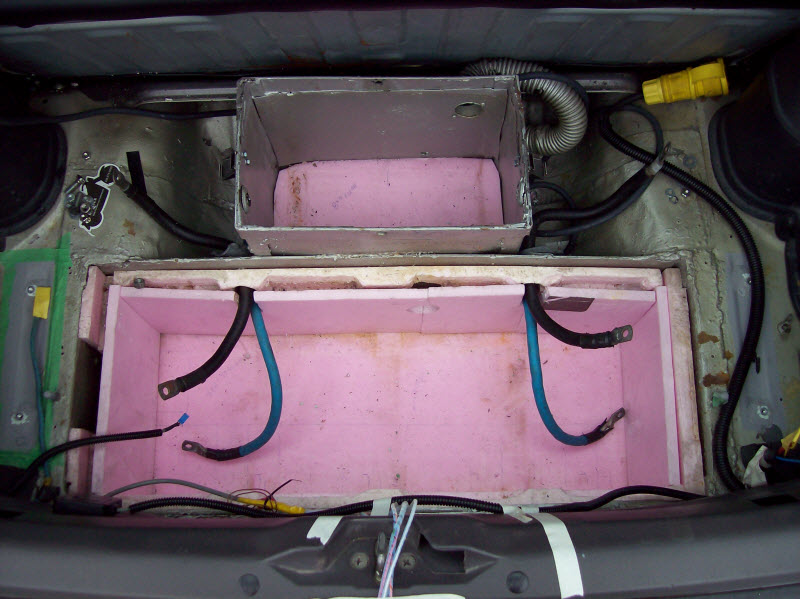
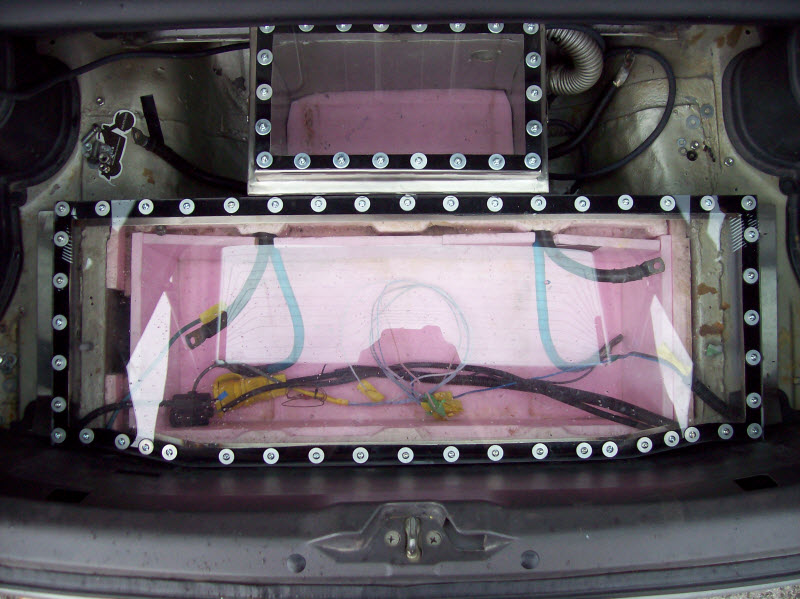
Not yet finished - but on it's way - finally! After having the Battery Box Covers made up for the rear Battery Boxes (long ago!) - I have finally got started on getting them fitted!
Since I had the batteries out - I started work on getting the cover installed for the single.
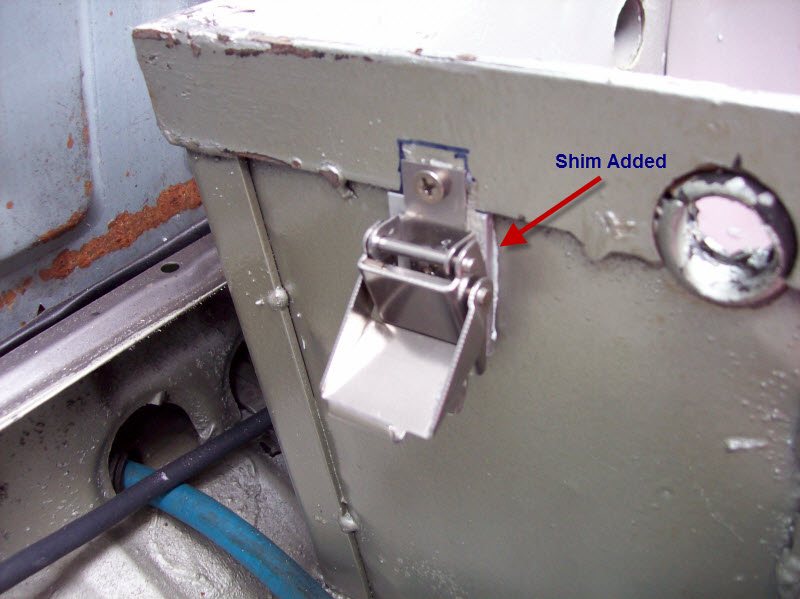
There was a flat strap around the edge - but not wide enough to hold the clamp down bracket - so I cut two pieces of 1/16" x 1" flat aluminum bar about 1.25" long, and secured them in place using 'Mighty Putty' Epoxy that I had, clamped them in place, and let them cure for a day.
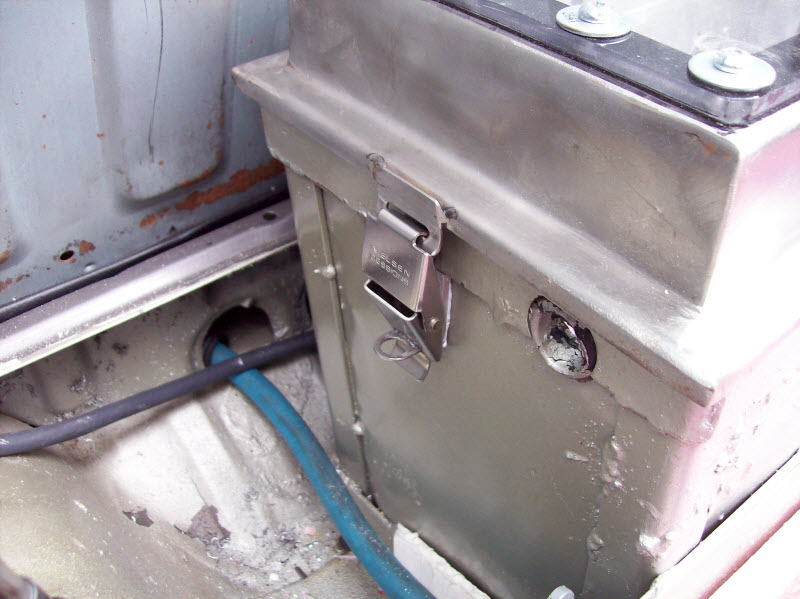
Then I used special Double Sided Sticky sheets, to temporarily hold the clips in place, aligning them by putting the lid on and clipping them to the closed position. After Carefully unlocking the lid, I clamped the clips in place one by one, and drilled first one hole, then bolted it and checked the cover fit - tweaking it for any alignment needs, before clamping the clip again to drill and bolt the second hole. I Did the same on both sides, then finished to tighten down the bolts.
With the single Battery Box Cover in Place - I began to deal with the issues of the main Rear Battery Box Cover and it's fit.
First - were the aft most flat edges, being at 90 degrees - they were scraping the plastic trim that was not in place when they were welded up, so I had to do some trimming and fitting - for a few fit cycles to get that right.
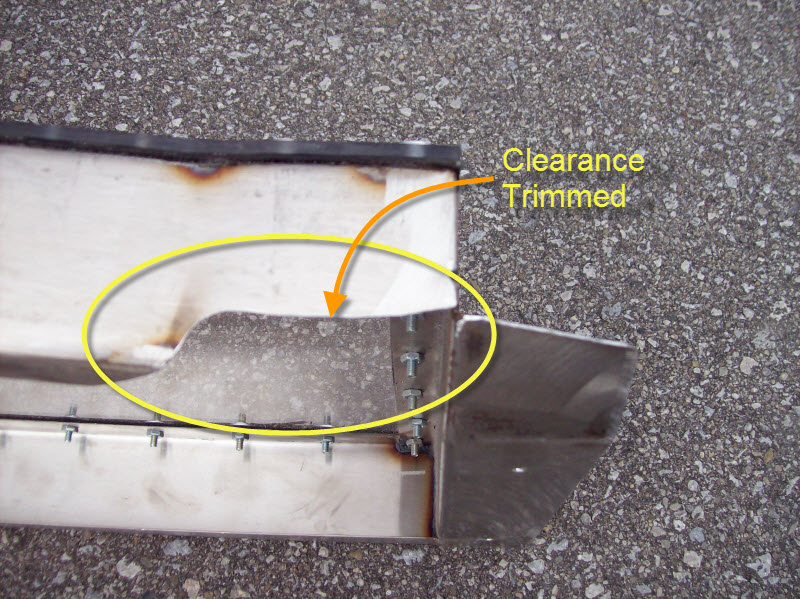
Then - was the issue of wire bundle clearance under the rear corners, and after hack-sawing, and grinding a few times, - I came up with cutting a much larger clearance, so I cut away more material, and used the 1" rotary File to Grind away and radius the corners for a safer, smoother clearance with fewer sharp edges.
Next - was the issue of the 4 original holes - that we first drilled in the side flanges along it's center-line, but they were along the edges of a dip, and on the side - where the hole - while vertical - would end up tipped inward on all 4 holes if I simply inserted the desired screw-nuts. So I decided to again get out the Mighty Putty - and simply use it to fill and level the space. First - I took my Wire Wheel (Actually - a synthetic replacement) in a 3" Dia. and using the Drill - I cleared away - Paint, Rust inhibitor, and underlying Rust, before using a small steam cleaner to cleanse the area of fine particles, dust, and crud. Drying that first with paper towel, and then my heat gun, I was then ready for the Might Putty!
After cutting 4 pieces of thin coat-hanger sized rod to insert in the 4 holes, I mixed the putty - one hole at a time, and then forced it into the depressed area an around the rod, wiggling the rod to keep the hole clear, and patting it down to make a basic Level condition. It was not until I got to the last hole - that I thought to use a stiff plastic Spreader - to pat it down in a true flat surface! (The others were already too hard to mold any more by that point.)
After letting them cure for about 10 more minutes - I got out the Heat Gun again - and gave them a bit of acceleration. Then - I started to mask off the area around each sides two holes, and once that was done - I shot them again with rust Primer, for a few coats and let them cure for another day!
After Removing the masking and paper, I chose the size of Screw Nuts (10-24), and drilled the insert hole for them. Unfortunately - I only had handy 1/4" drill bits, and needed a bit larger. So - I took a Round file and began to work the holes to make them larger - until the screw nut just slipped in.
Unfortunately - I made one hole a touch too large, and so - after installing the screw nuts, and fitting the cover, and testing the fit with bolts - the loose one pulled up. I will have to get a fresh one - and start again - but likely use a bit of fresh Mighty Putty with the install - or some other Epoxy - and let it cure before testing the tightening again!
Here are the two covers in place - with the smaller Single Batter Box Cover forward, and the large - 4-Battery Cover Aft:
Once that test fit is in place - the next step is to secure spacers for the flanges - using 1/2" thick Pink Builders Extruded Foam, adhesives, and Epoxies, etc. to set up a hard and level offset to raise the cover flanges up so as to clear the wiring that enters the battery box from the back face.
Wednesday, August 1, 2012
A Couple Free EV Fest 2012 Tickets for my Followers!
Coming to EV Fest 2012? Want in for Free? Just start By Clicking Here to get your 100% Discounted Advance Guest Tickets - On Me!
Oh - and I am getting some time to work on Electricfly - Have the Single Battery Box Cover Clips installed so I can Clip down and lock the Battery under a cover, as well as a Hold Down - keeping it away from prying fingers when I take it to shows - Like EV Fest 2012 Electric Vehicle Show!
Looking for More EV Fest 2012 Information - Come over to the site and See the Exhibitors, under the 'About' Menu item, or Get Tickets information under 'Tickets, etc. - go to EV Fest 2012 Electric Vehicle Show Website!
Saturday, May 12, 2012
EVCO EV Expo in Ottawa, Ontario - 1
Sitting in Brockville, on my way to the Electric Vehicle Council of Ottawa`s EV Expo! Have a stop to make' but should be there by lunch! I will see if I can get some good pics and info posted later.
Monday, March 12, 2012
Gas Pedal? What Gas Pedal? How about - How much Gas was saved?
Some people driving electric cars seem to get stuck on last century terminology - Gas Pedal! How about Accelerator Pedal? Or just Go pedal, the one beside the Stop pedal (The Brake Pedal)! Maybe we should color them Green for Go Pedals, and Red for Stop Pedals!
Also - some reports are coming in and say that Electric Car Sales have not exploded, so they must be dead!! Well - let's just compare - how many sales of other premium cars were there last year? (No - I don't have the answer - that's why it is a question!) Or - how about this - how many Extra Gallons (or Litres) of Gasoline were available for other drivers last year because of the electric Cars that did get sold?
Since an Electric car uses no Gasoline - ALL of the Gas it would have used if it were Gas Powered - is available for other cars! No Matter how many miles per gallon it would have gotten in a gas powered equivalent!
The Possibilities for an electric car to be fueled, if you will, by electrons moved by the sun, in your own properties space, via a Solar Photo-Voltaic panel (Solar PV, or Solar Electric), while likely a bit on the expensive side, generally have issues with creation, but cause so very little pollution with use as to be nearly non-existent, EV + PV = The True Green Solution!
Search EV + PV and you will find a number of sites on this subject! Like Jeff Chan's very descriptive pdf report by Sherry Boschert.
Beyond that - in My mind - Solar Power Production, in Work Parking Lots, that Feed the Grid, and as electric vehicles grow in numbers - charge them up - would do a lot to clean up local air conditions in Cities, and reduce the concentration of pollutants along road sides and in work site parking lots!
For those who want, but can't afford, an Electric Car, and want more than a 15 - 20 mph electric scooter, there are high powered electric scooters and Electric Motorcycles coming out now for 25% of the cost of an Electric Car, with - in some cases - even more range!
In all - the day of the Gas Pedal - is something your Grand Children might not even know about! Maybe even your children, if you are still young yet! Between Electric Vehicles, and Self-Drive Technology - either one or both of these items are likely to remove the terminology of the 'Gas' pedal from our vocabulary!
Enjoy your Gas Pedal While you can!
Wednesday, March 7, 2012
Discovery about the Trojan SCS150 Flooded Lead Acid Battery - the 1 Hr Rating!!!
I Finally found out the Actual 1 hour rating of the Trojan 100 Ah SCS150 12V Battery! It looks like Trojan Document MFSCS-6/01 and compares the Trojan SCS Series - the 150, the 200, and the 225: Group 24, 27, and 31 - Respectively, showing their performance from 1 - 25 hours!
It is rated at just 30 Amps for 1 hour! That is just 30 Amp Hours when compared to the 1 hour test ratings of the Lithium Iron Phosphate Cells! So the Blog Post - comparing the ThunderSky 40 Ah cells to the Trojan 100 Ah Cells - is not realy so bad after all - with 33% More Energy to 100% DOD versus the Lead Acid, and - interesting enough - the PRC-1255A Batteries I just tried in the car, as a new set - had a spec rating at 1 hour of 32.1 Ah - even more than the Trojan 100 Ah Batteries, and they are rated at just 55 Ah! Plus - the Weights:
Trojan SCS150 Group 24 100Ah rating at 20 hours (30 Ah at 1 Hr) Battery Weights 50 Lbs each x 8 = 400 Lbs.
Power Battery PRC-1255S, with a 55 Ah Rating at 20 Hours (32.1 Ah at 1 Hr), Weighs just 44 lbs per battery x 8 = 48 lbs less at 352 Lbs!
The Thundersky 40 Ah Lithium Iron Phosphate puts out a full energy of 40 Ah to 100% DOD at 1 Hr, and weighs just a maximum of 1.6 Kg per cell x 32 cells = 51.2 Kg = 112.64 Lbs!! just 2.25 Trojan Batteries weight by comparison!
Tuesday, February 7, 2012
SLA Power Battery PRC-1255S update
Had some Friends come over to help me try to get Electricfly Ready for EV fest 2011, almost made it - but had a charger problem - one of the custom chargers setups for the front 3 traction batteries, plus the accessory battery - failed on Traction Battery #2! The new Batteries I was putting in to try out - are smaller - only rated at 55Ah - but not much lighter at 44 lbs vs. the 100 Ah Trojans at 50 lbs! I heard some good things about them and some bad, plus these are used 24 - 30 months working in an Industrial UPS system - Emergency Lighting power, but I got them for Free, just check them and pick them up - so hard to complain, but when I tried to get a price on them new - the company was out of business!
Technically - they are rated at about the same capability as a ThunderSky 40 Ah Cell = 2 hours at 0.5C load = 40Ah for the TS, and 2 hours at 20.5 Amps for the Power Battery (just these are much heavier - 20 Kg vs ~6.4 Kg for the TS!)
For an interesting opening read on this - check out this question - What is the Cost of a Pound? pdf document!
In any case - I have also since found one installed in the back to not hold a charge well, so have to swap it with a spare I kept!
Friday, January 20, 2012
My Electricfly - Plans to exhibit at EV Fest 2012
| EV Fest Electric Vehicle Show 2012 I'll be at EV Fest 2012! See my Electricfly at Evergreen Brick Works! 550 Bayview Avenue, Toronto, Ontario, Canada Join us in The Pavilions! Sunday, September 9th! Hours: 10AM - 5PM! |
If you have a Personal Electric Vehicle, and would like to Exhibit it at EV Fest 2012, now is the time to get your plans ready and get Ahead of the Curve! Check out the website for more information!